
October 28, 2026 · 11 min read
LinkedIn algorithm 2026: reach down? Wrong lever.
LinkedIn now ranks the feed by reading each member's history, not just the post. Most guides tune the post. The lever is the history, and much of it is written in other people's comments.
Your reach fell. Everyone’s did. The guides tell you to fix the hook, the format and the hour. LinkedIn’s own engineers describe a system that reads history first and the post second.
Key Takeaways
- In March 2026 LinkedIn rebuilt feed ranking around a Generative Recommender that treats each member’s feed history as a sequence and processes more than a thousand of their past interactions (LinkedIn Engineering)
- Posts are matched to readers by topic, “whether they come from your network or professionals you haven’t met yet”. LinkedIn’s stated aim: a feed “relevant to your interests, not a popularity contest” (LinkedIn)
- LinkedIn says it is cutting engagement bait, “comment to agree” prompts, engagement pods and comment automation. Gaming the post is getting harder. Building the history is not.
- The lever most guides skip is showing up in your topic, daily, in other people’s comment sections. Comments drove 79.9% of where I appeared on LinkedIn in a month (my own LinkedIn analytics)
Every autumn the same post goes round. “LinkedIn changed the algorithm. Your reach is down. Here is what to do.” The fix is always a new hook formula, a new format, a new best hour. Try them. Watch the next post land in the same place.
It lands in the same place because the post was never the main variable. LinkedIn has now said, in its own engineering write-up, what the main variable is: history. The feed is ranked by a model that reads what each member has done, a thousand interactions deep, and only then looks at your post.
This article is about where that history gets written. Most of it is not on your profile.
Is LinkedIn reach really down in 2026?
For most accounts, yes, and the cause is structural, not personal. Your posts used to compete mainly with your connections’ posts for your connections’ attention. Now they compete with every post on LinkedIn about your topic, because the feed picks content “whether it comes from your immediate network or professionals you’ve never connected with before” (LinkedIn Engineering).
That cuts both ways. A stranger who has never heard of you can now see your post if their history says they care about your topic. A connection who has not engaged with your topic in months can stop seeing you entirely. Reach no longer follows the size of your network. It follows the fit between what you publish and what each reader has been doing. The follower side of this has its own article.
So the drop everyone is panicking about is real, and it is not a punishment. The useful question is which part of the new system you can still move.
How does the LinkedIn algorithm work in 2026?
One model, not a rulebook. In March 2026, LinkedIn said it is “upgrading how the Feed ranks content using larger sequence models, known as Generative Recommenders, augmented with large language models” (LinkedIn). The engineering write-up spells out what that means: the model “reimagines ranking by treating your feed interaction history as a sequence”, and it “processes more than a thousand of your historical interactions” (LinkedIn Engineering).
Three details in that write-up matter more than any hook formula.
Your actions are the input. “Long dwells, likes, comments, shares” are embedded and interleaved with the posts they were attached to. The model is not reading your profile summary. It is reading what you did.
Skips count too. The training data includes “all impressed posts”, both the ones members engaged with and the ones “they scrolled past”. LinkedIn has worked this way for years: its 2020 dwell-time work lowered a post’s ranking score in proportion to the predicted chance that a member would skip it (LinkedIn Engineering). Being seen and ignored is a signal.
It follows a trajectory. The engineers’ own phrase: “a sequential model understands the trajectory.” Interests change over time and the model expects them to. What you did last month counts. What you did this week counts more.
LinkedIn’s research paper on its 360Brew ranking model described the same idea from another angle: a single 150-billion-parameter decoder-only model built by “verbalizing member behaviors and their social connections” (arXiv 2501.16450, v4, August 2025; the listing now carries a withdrawal notice over its licence). Your history is turned into context for the model. The post is the last line of a long prompt.
Every guide on page one of Google is tuning that last line: hooks, carousels, posting hours. Useful, within limits. The history sits there untouched. So where does it actually get written?
The lever: your history is written in other people’s comment sections
Look at the model from the reader’s side. Who sees your next post depends on what each potential reader has engaged with, a thousand interactions deep, in order. Every time one of your buyers stopped on something you wrote, replied to it or liked it, that became part of their sequence. The more often you appear in that sequence, on the topic you want to be known for, the better the fit when your next post comes up for ranking.
That is my reading of LinkedIn’s description, not LinkedIn’s claim. But notice where most of those appearances can happen. Not under your posts. Under other people’s.
A post goes out a few times a week. A comment can go out every day, in the threads your buyers already read, under posts the model already knows they care about. My own split: comments produced 79.9% of where I appeared on LinkedIn in a month; posts produced 18.8% (my own LinkedIn analytics, also shown in the comment-first tactics piece).
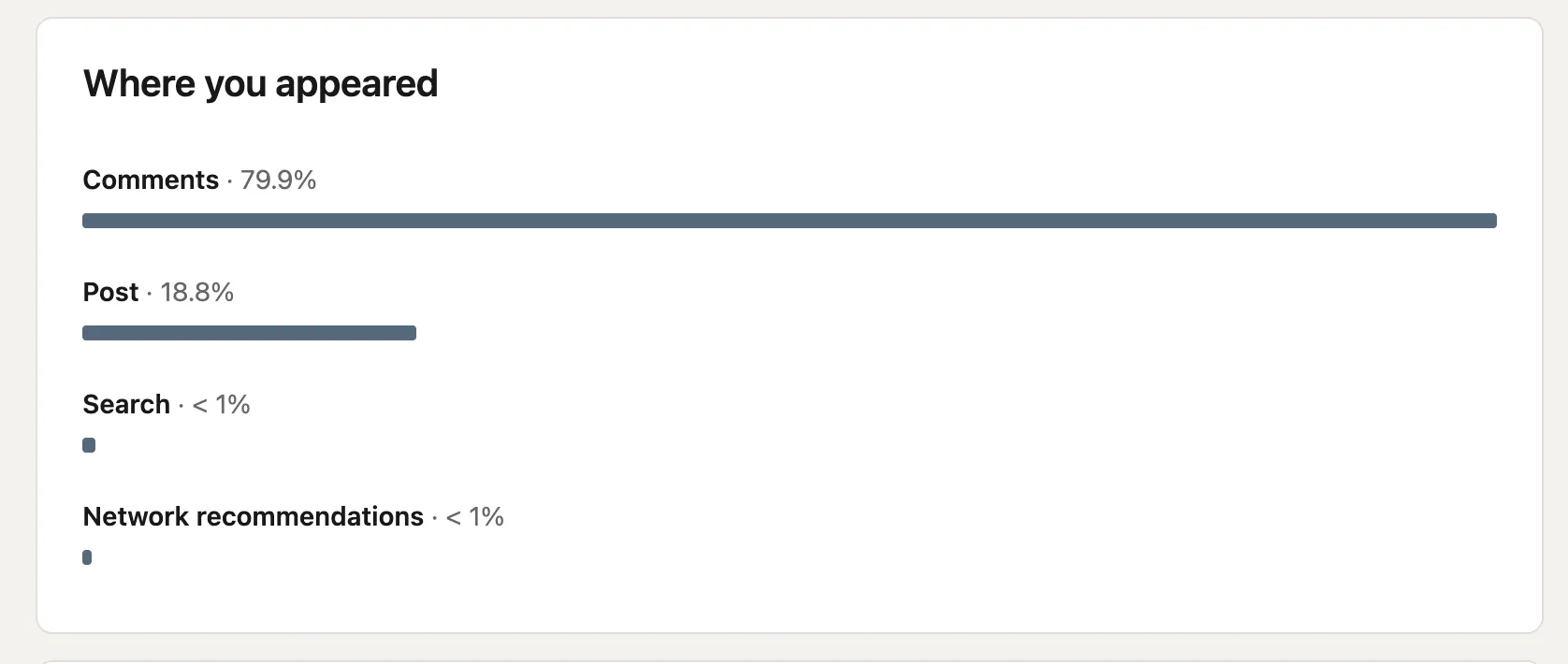
Where I appeared on LinkedIn: comments first, posts a distant second. My own LinkedIn analytics.
How the Interest Graph files you under a topic, and why your comments count toward that filing, is covered in its own piece. The point here is simpler. The part of reach most guides ignore is a running record of what you did in other people’s threads. A like is a tip you leave. A comment puts your name in their history.
Why it has to be daily, and why it has to be focused
“Comment more” is advice everyone has heard and almost nobody follows, because it sounds like virtue. It is not virtue. It is how a sequence model works.
Regularity builds the pattern. A model that reads a thousand interactions in order learns from repetition. Showing up on the same people’s posts week after week makes you a recurring line in their history, and them in yours. Reach on LinkedIn is reciprocal before it is viral. The comment you leave this week is the feed placement you get next.
Consistency beats volume. The model expects interests to move (“If your interests shift, the model adapts within the same session”), so a burst of activity two months ago says little about what you are doing now. A 20-minute window every weekday leaves a steadier trail than a two-hour session twice a week. That is an inference from how the model is built, and it matches what my own analytics show.
Focus is what makes the trail readable. LinkedIn says its new systems “better understand what a post is actually about” (LinkedIn). Commenting on content that has nothing to do with your buyers puts you in the wrong histories and blurs your topic. Stay one or two steps adjacent to your niche, not ten. And comment while a post is still circulating: a comment on a post nobody is being shown any more is read by almost no one.
This is why a curated list beats the feed. The feed is built to make you scroll. The list is built to make you consistent.
What LinkedIn says it is turning down
The negatives are now on the record, in LinkedIn’s own words. It is reducing “repetitive, low-substance posts and engagement bait”, including “‘comment to agree’ prompts or videos that don’t match the text”, and cutting “recycled and click-driven posts”. It is moving to “curb comment automation or third party tools that create fake conversations”, and names engagement pods and unauthorized third-party tools alongside them (LinkedIn).
In July it added a “Seems like AI slop” report option (TechCrunch), covered in what the slop button actually changes. The pods that manufacture early engagement sit on the same list.
Read together, the list says one thing: anything that inflates a post without changing what real people do is being discounted. What LinkedIn says it wants instead is “more posts that offer genuine insight, actionable ideas, and thoughtful perspectives”. That is the case for writing a LinkedIn post that gets comments, and for showing up in the right comments. The algorithm is not counting engagement. It is reading behaviour.
What counts as a LinkedIn impression, and what to watch
An impression is a view, not a person, and LinkedIn now counts them for comments too. Its help centre defines a comment impression as counted each time someone views your comment; only you can see the figure, and it shows on the comment itself, with no dashboard behind it (LinkedIn Help). That is the number to watch if you take the previous sections seriously.
As for what is normal, judge each post against your own typical numbers, not against someone else’s screenshot. Reach depends on how well a post fits the histories of the people it could reach, so a benchmark from another account in another niche tells you very little. And give a post a week before you decide what it did.
The part you cannot control
Timing, competition, trends. They matter, and they are the part every guide obsesses over. Worth knowing. Not worth a calendar obsession. A model that reads a thousand interactions of history is not going to be won over by the minute you hit publish.
Pick a sane cadence, a few posts a week you can actually attend, and leave the rest. You cannot schedule your way into someone’s history. You can comment your way into it.
How to pull the lever in 15 minutes a day
Start with how you split your time. Give commenting a real share of your active LinkedIn time, not the leftovers after publishing. Posting builds authority. Commenting builds reach, relationships and pipeline at the same time.
In practice that is a list and a window. A curated list of 100-200 names, prospects, customers, peers and the voices your buyers already read, in chronological order so the newest posts surface first. Fifteen minutes, same time every weekday. Like, comment or skip. Two or three comments that carry a standalone point: a data point, a counter-example, a question with a real answer behind it. That is the whole routine, and it is the one BossFeed was built around, because the native feed will not give you a chronological list of two hundred names no matter how carefully you follow people.
The hard part of a standalone-value comment is not the writing. It is knowing what the post is really saying, what it left out, and where the thread is about to go. That is what I read before I type: the claim, why it lands, the gap, the likely replies. Not a draft. Context.
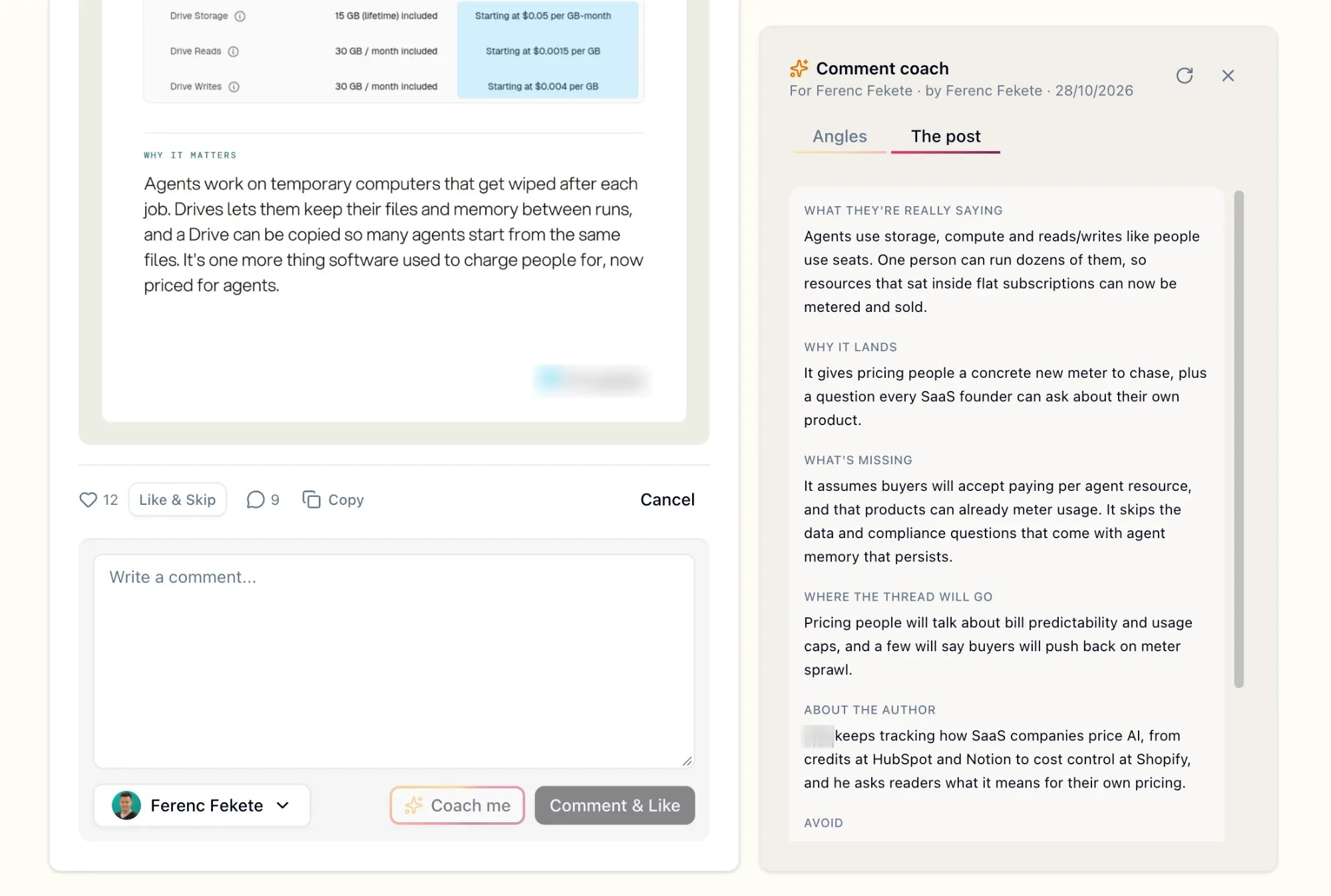
The coach view on a post from my feed, read before writing. The comment box stays empty on purpose. My own account; the post’s author and company are blurred.
On your own posts, the same logic runs in reverse. Reply early. Leave a value-add comment or two of your own, because author comments sit near the top of the thread. When someone replies with a real point, do not answer “thanks” and move on; that “thanks” is where most of the pipeline value is left on the table.
Be honest about cadence. My routine lands two or three substantive comments a day, plus the likes and the skips. Pick a number you can keep, because what the model sees is the pattern, not the total. Posting more will not fix a thin history. Showing up will.
Frequently Asked Questions About the LinkedIn Algorithm
Why did my LinkedIn reach drop in 2026?
Because the feed changed, not because your writing did. LinkedIn now ranks the feed by topic, reading each member's interaction history and choosing posts whether they come from that member's network or not. Your posts compete with everything on your topic, and connections who have not engaged with your topic lately may stop seeing you. Most of what you can still move is your own history: how consistently you show up in your topic.
How does the LinkedIn algorithm decide who sees my post?
Since March 2026, a Generative Recommender ranks each member's feed by treating their history as a sequence: more than a thousand past interactions, including long dwells, likes, comments and shares, plus posts they scrolled past (LinkedIn Engineering, 2026). Your post reaches people whose history says your topic is relevant to them, whether or not they follow you.
Do comments or likes matter more to the LinkedIn algorithm?
Both are inputs, but they do different work. LinkedIn's model reads likes and comments as separate actions in a member's history, and LinkedIn says it wants the feed to reward genuine insight and thoughtful perspectives while it curbs comment automation and 'comment to agree' bait. A like helps the author. A substantive comment also puts your name, and your thinking, in front of everyone reading that thread.
What is a good number of impressions on LinkedIn?
There is no universal benchmark, because reach depends on how well a post fits the histories of the people it could reach. Judge a post against your own typical numbers, give it a week before deciding, and remember that comments earn impressions too: LinkedIn shows a comment impression count on each comment you leave.
How often should you comment on other people's posts to grow your own reach?
Daily, in a fixed window, on a focused list. A twenty-minute daily block beats an occasional long session because a sequence model learns from patterns over time, not bursts. Keep the list to people one or two steps from your niche, comment while their posts are still circulating, and bring a point the post did not make. Two or three substantive comments a day is my floor. Kept up for months, that is what builds the history the feed reads.
Your next post’s reach is being shaped this morning, in someone else’s comment section.

Co-founder, BossFeed, VeryCreatives