
June 15, 2026 · 6 min read
LinkedIn growth hacks: 6 comment-first tactics that actually work
Most LinkedIn advice says post more. My comments out-reach my posts several times over. Here are six comment-first tactics that work, and the daily routine behind them.
Last month, comments drove 79.9% of where I appeared on LinkedIn, not my posts. Here is the playbook, and the proof from my own analytics.
Key Takeaways
- Comments drove 79.9% of where I appeared on LinkedIn last month. My posts drove 18.8%. Same person, four times the reach from comments (my own LinkedIn analytics).
- Two single comments earned 5,363 and 9,350 impressions, more than most of my posts (my own LinkedIn analytics).
- Six comment-first tactics, plus the 15-minute daily routine I use to run them.
Every LinkedIn growth guide says the same thing. Post more. Post consistently. Feed the algorithm.
I do close to the opposite. I publish maybe once a week. And when I checked where I actually showed up on LinkedIn last month, the split was not close: comments 79.9%, posts 18.8%, everything else under 1% (my own LinkedIn analytics).
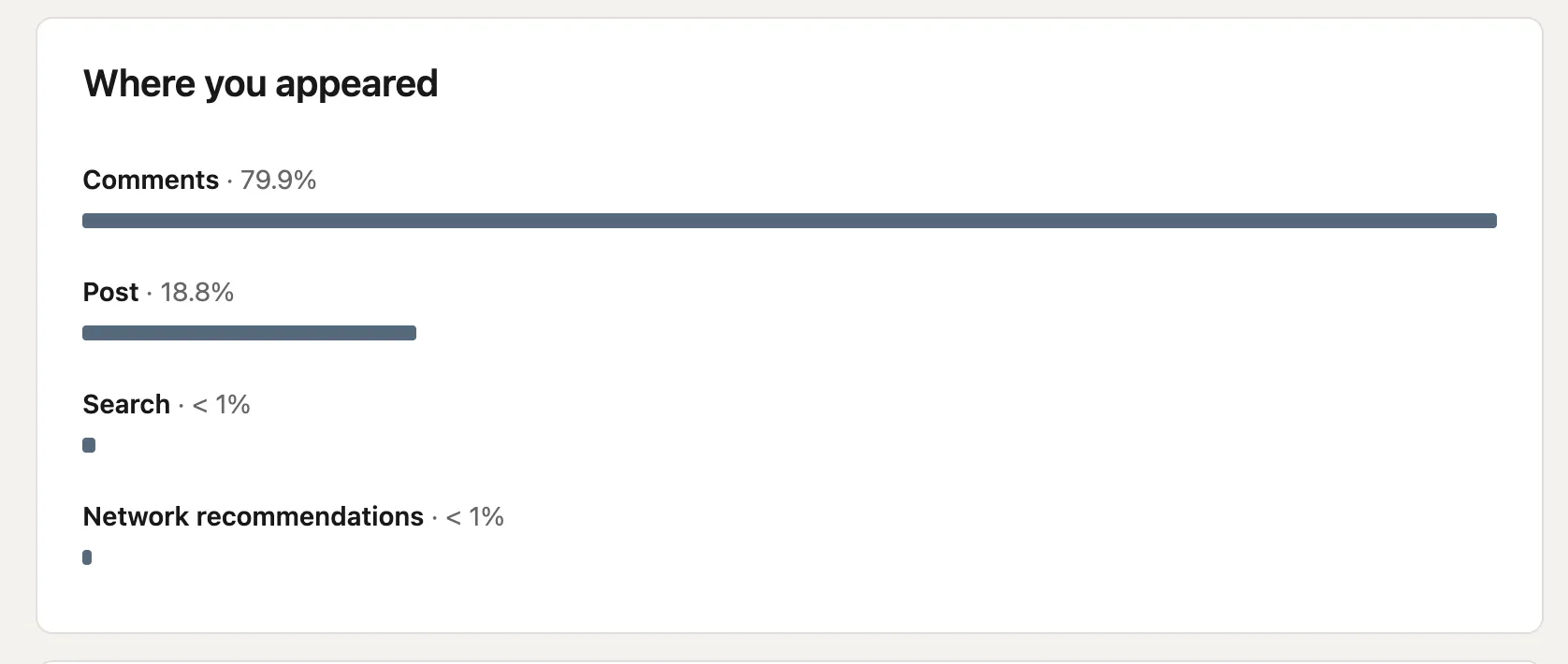
Where I appeared on LinkedIn last month. Comments 79.9%, posts 18.8%. My own LinkedIn analytics.
Read that again. Four out of five times someone saw me on LinkedIn, it was because of a comment I left on someone else’s post. Not because of anything I published.
Here are the six comment-first tactics behind that, and the daily routine I run to make them happen. None of this is secret. Most good LinkedIn operators do some version of it. Almost nobody tells you to lead with it.
The proof: two comments, thousands of views
Here are two comments I left in the last week.
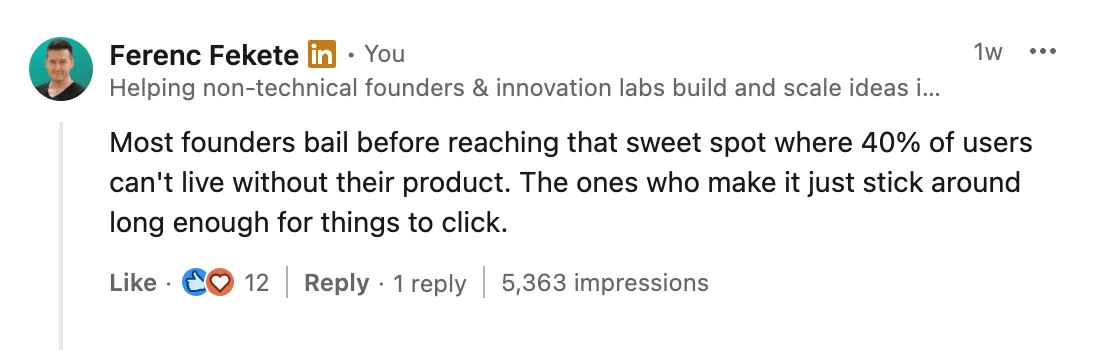
5,363 impressions, 12 reactions, from one comment. My own LinkedIn analytics.
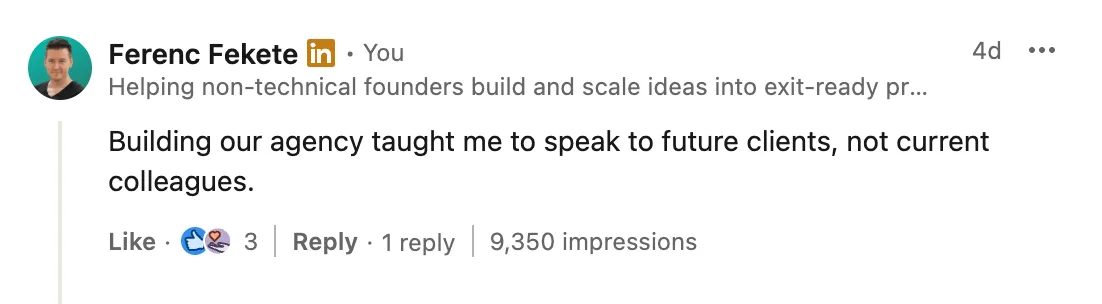
9,350 impressions from one comment, with fewer reactions than the first. My own LinkedIn analytics.
Look closely. The second comment got fewer reactions than the first and almost twice the impressions. That is the whole game in two screenshots: the reach of a comment depends far more on the post you choose than on how many likes your comment collects. Pick the right room, and a single paragraph does the work of a week of posting.
Tactic 1: Comment early on the posts your buyers already read
The single most valuable move on LinkedIn is a substantial comment, left early, on a high-visibility post in your niche. You borrow that author’s audience for a paragraph. The 9,350-impression comment above was on a large post in my space, left inside the first hour.
There is one line you cannot cross: the comment has to add real value. Something that could stand on its own as a short post, a counter-example, a specific number, a sharper way of saying what the author was reaching for. The moment it reads as “great post” or a veiled pitch, the audience knows, and so does the algorithm.
Tactic 2: Comment before you post
In the hour before I publish anything, I spend ten minutes commenting on posts from the exact people I want seeing mine: a mix of prospects I am not connected to yet and people I already follow.
By the time my post goes live, I have just shown up in their world with something useful. The post lands warmer, in front of an audience I primed by hand minutes earlier. It is the cheapest pre-launch you will ever run.
Tactic 3: Add a strategic self-comment to your own post
Within the first hour of publishing, I drop a substantial follow-up in my own comments: a mini-case, a checklist, a counterpoint, or a real question for the reader.
It extends how long people stay on the post, and it gives them more places to reply. A post with one good thread under it travels further than the same post sitting silent. The catch is the same as everywhere else: the add-on has to genuinely add something, not just bump the post.
Tactic 4: Tag power readers, not power names
Stop tagging big names who never reply. A tag that gets ignored is a quality signal working against you.
Instead, find three to five people who actually engage and sit close to your ideal customer, and tag them with a specific question that references their expertise. They reply because you made it easy and flattering to. The thread gets richer, and your content lands in front of exactly the right second-degree audience.
Tactic 5: Turn post engagement into a warm-outreach list
After a post does well, I do not just enjoy the likes. I look at who engaged, focus on the second and third-degree people outside my network, and send a few personalized connection requests that reference the exact post they engaged with.
It is warm, it is specific, and it converts far better than cold outreach, because the conversation already started. Engagement becomes pipeline instead of vanity.
Tactic 6: Give a strong post a second life
When a post worked, I do not move on to the next idea. A week or two later I repost it and add two substantive comments to the thread.
The algorithm reads the repost plus fresh comments as renewed engagement. And it barely matters that the audience saw it once, because most of them did not, and the ones who did have already forgotten. One strong idea, worked twice, beats two new ideas left to fade.
How I run all of this in 15 minutes a day
This sounds like a lot. It is not, because the hard part is not the commenting. It is finding the right posts before everyone else does. That is what used to kill the habit for me: open LinkedIn, get buried under engagement bait and recruiter spam, never find the people who actually matter, give up by week two.
So I run the whole routine inside BossFeed. I keep a curated feed of the 100 to 200 names who matter, prospects, customers, peers, so the posts worth commenting on early surface in one place, in chronological order. I work the queue with a quick like, comment, or skip, leave two or three standalone-value comments, do the pre-post pass on prospects’ posts, then pull the list of who engaged for outreach. Fifteen minutes, same time every morning.
The tool is not the point. The habit is. It just removes the one excuse that kills the habit: not being able to see the right posts in time to be early.
Frequently Asked Questions About LinkedIn Comment Growth
Do LinkedIn comments really get more reach than posts?
In my case, dramatically. Last month, comments drove 79.9% of where I appeared on LinkedIn and my posts drove 18.8% (my own LinkedIn analytics). Your split will differ, but the direction is consistent: a good comment on someone else's post borrows an audience you would have to spend months building yourself.
How do you get thousands of views on a single comment?
Comment early, with real value, on a high-visibility post your audience already reads. One of my comments earned 9,350 impressions with only three reactions (my own LinkedIn analytics), because the post it sat under was big. The room you pick matters more than the likes you collect.
Isn't jumping into other people's posts just spammy?
Only if you add nothing. The line is genuine value: a comment that could stand alone as a short post. Drop a "love this" or a thinly veiled pitch and you get the opposite of reach. Add a real idea and you get borrowed attention from exactly the right people.
How long does this take each day?
About 15 minutes, if you have a curated feed of the right people. The time sink was never the commenting. It was finding the posts worth commenting on before the thread filled up. Solve that and the habit fits in a coffee break.
Everyone is optimizing the post. The post is the hard way in. The comment is the side door, and it is wide open.
Most of your audience will never see what you publish. They will see what you say on someone else’s post. So go say something worth seeing.
If you want the habit behind this, start with why commenting beats posting and how to see the right posts early. And if a shortcut is tempting you, read about the purge coming for engagement pods before you rent your reach.

Co-founder, BossFeed, VeryCreatives