
June 1, 2026 · 6 min read
Why founders who comment daily grow faster on LinkedIn
Comments out-reach posts on LinkedIn, and the published data backs it. The daily commenting strategy founders use to turn visibility into pipeline and leads.
The most valuable thing you can do on LinkedIn is not post. It’s show up, every day, in other people’s comments.
Key Takeaways
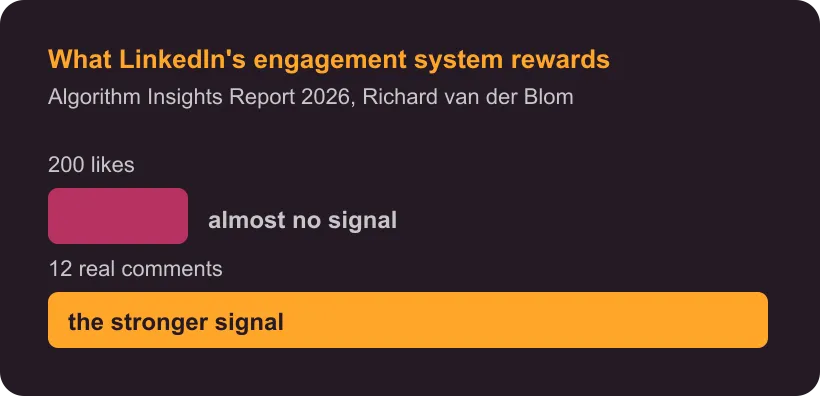
- LinkedIn’s engagement system now weighs 12 real comments more heavily than 200 likes. Substance beats volume (Algorithm Insights Report 2026, Richard van der Blom)
- Replying to comments lifted engagement by around 30% across an analysis of 72,000 posts, and helped 83% of profiles (Buffer)
- LinkedIn is the channel 89% of B2B marketers use for lead generation (Sopro, 2025). The daily habit that captures it: a curated list, a fixed 20-minute window, and a quality bar of two or three real comments.
For years the LinkedIn advice has been the same. Post more. Publish consistently. Feed the algorithm. It is not wrong, exactly. It is just aimed at the wrong half of the platform.
The half that actually moves pipeline for most founders is the half you do not control: other people’s posts. Showing up there, daily, with a real opinion, is the most underrated growth habit on LinkedIn. And the published data backs that up.
Why commenting beats posting
A thoughtful comment on someone else’s post is read by everyone who reads that post. You borrow their audience for a paragraph. A good comment in front of the right audience converts the way a good post in front of the wrong one never will.
LinkedIn’s own ranking rewards this. Its engagement system now weighs 12 real comments more heavily than 200 likes, and a two-sentence comment that adds a data point or a counter-perspective carries far more weight than a one-liner (Algorithm Insights Report 2026, Richard van der Blom). A like is a dead end. A comment is a door.
The reverse is now getting enforced. Platforms are actively purging manufactured engagement, which is why engagement pods are dying.
What the data says about showing up
This is not a vanity-metric story. Replying to the comments on your own posts produced about 30% higher engagement, and helped 83% of the profiles studied, across an analysis of 72,000 posts from nearly 25,000 accounts (Buffer). Engagement compounds. More visibility this week is more reach next week.
And it ends in pipeline. LinkedIn is where B2B buyers are: 89% of B2B marketers use it for lead generation, more than any other channel (Sopro, 2025). The founders who show up in the right conversations are the ones those buyers see first.
Why this is hard to do
It is not hard because commenting is hard. It is hard because the LinkedIn feed is engineered to make sure you never see the right posts to comment on.
The algorithm rewards engagement bait. It rewards length. It rewards your second cousin’s job announcement. It does not reward “the post from a prospect you have been quietly nurturing for six months.”
Anyone who builds a real commenting habit has to solve the feed problem first: how do I see the right posts, in chronological order, from the people I actually care about? Without that, the habit dies in week two, buried under MBA inspiration and recruiter spam.
The daily habit that actually works
Every founder I have watched make this work runs the same three-part routine. None of it is sophisticated. All of it is a decision.
A curated list, not a follow list
A separate, intentional list of 100-200 profiles: prospects, customers, peers, industry voices. Rebuilt quarterly. Pruned aggressively.
This list is the feed. Everything else is noise. The follow count on your profile is irrelevant. What matters is whether the right twenty posts show up, in chronological order, when you sit down at 8:45am.
A fixed daily window, not “fitting it in”
Twenty minutes. Same time, every weekday. Most often before 9am.
The founders who try to “fit it in” do not fit it in. The ones who block the calendar and treat it like a meeting do. A commenting habit that depends on motivation fails by month two. One that depends on calendar discipline survives.
A quality bar, not a volume target
Do not aim for ten comments. Aim for two or three that another human being would actually want to reply to.
“Great post” is a non-starter. “I disagree, here’s the counter-example from my own data” is the move. So is a specific follow-up question, a named case study, or a short observation that builds on the original post’s point without just agreeing with it.
What a good comment looks like
Three things show up in every comment that earns a reply. It is specific: it names something in the original post directly. It adds something: a point or angle the original did not include. And it is short. Under 100 words. Long comments rarely outperform short, precise ones.
What does not work: “Great post.” Agreement dressed up in complete sentences. Anything beginning with “As a [job title]…”
The full set of advanced moves, including when and where to place these comments, is in the comment-first tactics.
What this does not mean
None of this means stop posting. Posting is how prospects find you in the first place. It is the context that makes your comments credible. A comment that sends someone to a blank profile wastes whatever goodwill it built.
The point is the order of operations. Most founders run it as write, schedule, post, hope, and leave the most valuable work on the table. Showing up in other people’s posts is where the second-order pipeline lives. The DMs. The warm intros. The “I saw your comment on Anya’s thread” emails.
It is, in the end, the unflattering observation: most of the value LinkedIn offers a founder is not on your profile. It’s on everyone else’s.
Frequently Asked Questions About LinkedIn Commenting
How many LinkedIn comments should I post per day?
Two or three real ones beat ten throwaways. Consistency matters more than volume, because the engagement gains compound over weeks, not days. Pick a number you can sustain every weekday, then protect the calendar slot. The founders who treat it as a standing appointment keep it. The ones who improvise drop off by week two.
Do LinkedIn comments actually generate leads, or just vanity metrics?
Leads. LinkedIn's engagement system weighs 12 real comments above 200 likes (Algorithm Insights Report 2026, Richard van der Blom), and LinkedIn is the channel 89% of B2B marketers use for lead generation (Sopro, 2025). Visibility in the right conversations is what puts you in front of buyers before they are ready to buy.
What makes a comment get a reply instead of being ignored?
Three things: it is specific, it adds something, and it is short. Name something from the original post directly. Add a point the author did not make, like a counter-example, a data point, or a follow-up question with a real answer behind it. Stay under 100 words. The simplest test before posting: would the author want to respond to this?
Does posting on LinkedIn still matter if I focus on commenting?
Yes. Posting is how prospects find you in the first place, and it builds the credibility that makes your comments land. Treat posting as the foundation. Treat commenting as the daily engine. The strongest founders do both, with comments as the daily habit and posting as a weekly practice.

Co-founder, BossFeed, VeryCreatives