
August 5, 2026 · 7 min read
LinkedIn's AI slop button is really about comments
LinkedIn shipped a button to report AI slop, and everyone argued about it. The real story is the comment war underneath it, and the line between assisted and outsourced.
The button got the headlines. The number underneath it got almost none: LinkedIn is blocking automated comments by the hundreds of thousands, every day.
Key Takeaways
- On July 30, LinkedIn shipped a “Seems like AI slop” report option. Flagged posts help train detection models and get less reach in recommendations beyond your network (TechCrunch)
- The quieter, bigger number: LinkedIn already blocks hundreds of thousands of automated comment attempts every day, plus millions of other automation attempts in recent months (same source)
- LinkedIn is also retiring its own “Enhance your post” AI rewriter and testing a private inauthenticity flag in your analytics, not a public pile-on
- The direction is clear: the platform is drawing a line between AI-assisted and AI-outsourced. Which side of it you engage from is about to matter.
On July 30, LinkedIn added a new option to the three-dot menu on every post: “Seems like AI slop.” One click, the post disappears from your view, and LinkedIn’s systems get a signal.
The internet spent the week arguing about the button. Fair enough. A report button with no shared definition of “slop” deserves some argument.
But the button is not the story. The story is what LinkedIn disclosed alongside it, and what it tells you about where engagement on this platform is heading.
What is AI slop?
AI slop is low-effort, mass-produced AI-generated content: generic, interchangeable posts and comments published at scale with little or no human thinking behind them. The term describes outsourcing, not assistance. A post you wrote and polished with AI is not slop. A post AI wrote while you watched is.
That distinction is not ours alone. It is the one LinkedIn itself is now building around: assistance gets a proofreader, outsourcing gets a report button and a classifier.
What does the AI slop button actually do?
Three things, per LinkedIn’s own description of the feature (TechCrunch).
It hides the post from your feed immediately. It feeds your report into the models LinkedIn uses to identify slop. And it reduces the visibility of flagged content in recommendations beyond the author’s network. “AI slop is a top priority for all of us,” LinkedIn’s Chief Product Officer Hari Srinivasan said with the launch. “People come to LinkedIn to connect with real people and share their real perspectives, ideas, and expertise.”
What LinkedIn has not spelled out is what happens when a post crosses some threshold of reports. Until it does, treat the button as a signal into a system, not a verdict.
The number nobody led with: the comment war
Buried in the same announcement: LinkedIn blocks hundreds of thousands of automated comment attempts every day, and has stopped millions of other automation attempts, posting at scale, slop, in just the past couple of months (TechCrunch).
Read that again. Every day, a small city’s worth of fake comments tries to get onto the platform, and gets caught by classifiers before any human sees them or presses any button.
Three weeks ago we wrote that the authenticity purge was coming for LinkedIn engagement pods, the same way it came for Reddit’s seeded posts. This is that prediction, confirmed by the platform’s own product chief, with the enforcement aimed squarely at the place we said it would land: the comments. If your engagement strategy involves a tool that comments for you, you are not competing with other creators. You are competing with a classifier that already wins hundreds of thousands of times a day.
Are AI detectors accurate?
Here is the uncomfortable question under the whole feature, and the honest answer is: not reliably, and the best evidence comes from the people with the strongest incentive to build one.
OpenAI shipped its own AI-text classifier in 2023 and shut it down within six months for what it called a “low rate of accuracy.” By its own numbers, the tool caught just 26% of AI-written text and falsely flagged 9% of human-written text as AI (Search Engine Land). The company that makes ChatGPT could not reliably detect ChatGPT.
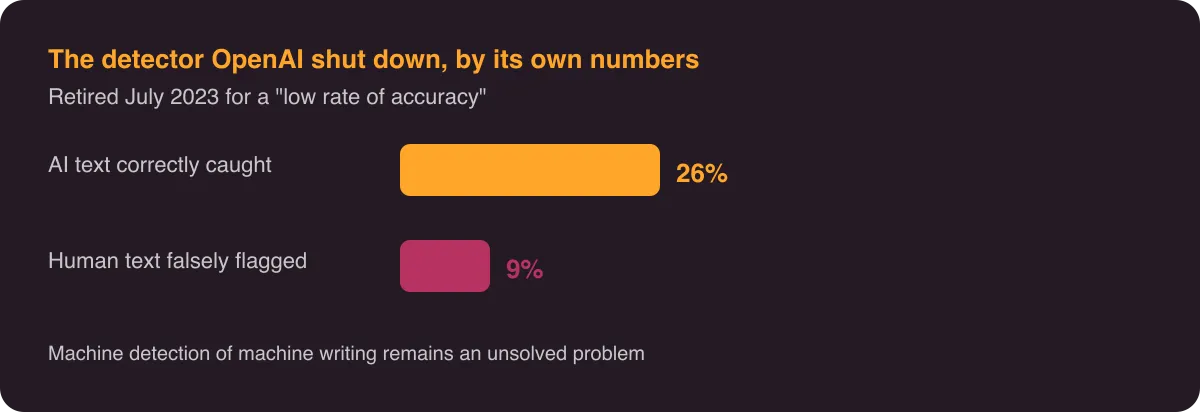
OpenAI’s own classifier caught 26% of AI text and falsely flagged 9% of human text before being retired. Source: Search Engine Land.
Now hand that unsolved problem to a crowd. A report button with no shared definition of slop is a filter, but it is also a weapon: the competitor you outrank, the client who left on bad terms, anyone with a grievance and a mouse gets a vote on whether you sound human. That is the legitimate worry about this feature, and LinkedIn seems to know it, because the follow-up plans point the other way: a flag that appears privately in your own analytics when readers find your content inauthentic. A quiet signal to adjust, not a public dogpile.
Assisted or outsourced: the line LinkedIn is drawing
The most telling detail of the whole announcement is the one that got the least coverage. LinkedIn is retiring “Enhance your post,” its own AI feature that rewrote your drafts, and replacing it with one that proofreads your words without changing your voice (TechCrunch).
Sit with the irony for a second: the platform fighting AI slop concluded that its own rewriting tool was part of the problem. Then notice the principle in the correction. Fix the grammar, keep the human. Assistance survives. Outsourcing gets flagged.
That line runs straight through engagement too, and it is the line we build on: use AI to understand a post, its author, and the conversation, then write the comment yourself. That split, context from the machine and words from the human, is the entire design premise of BossFeed, and as of this month it is also, visibly, the platform’s direction.
What to do now
Nothing here threatens anyone who engages like a human. If anything, the classifiers are clearing your competition.
- Write your own comments. Every automated one is now a coin flip against a system that blocks hundreds of thousands a day. The comment-first playbook works precisely because no tool can fake it.
- Keep AI on the assistance side of the line. Research, context, proofreading: fine. Ghostwriting your voice at scale: that is the pattern every one of these systems is being trained to catch.
- Substance is the best defense against false flags. A comment with a specific number, a real disagreement, or a lived example does not read as slop to a human or a model. “Great post” always did.
- If the private flag ever appears in your analytics, treat it as data, not an accusation. It is telling you your voice is disappearing from your own content.
The deeper play has not changed since the pods piece: earned engagement compounds, rented engagement is one purge away from zero, and showing up daily in real conversations is the one strategy every one of these enforcement waves rewards.
Frequently Asked Questions About LinkedIn AI Slop
What is AI slop?
Low-effort, mass-produced AI-generated content: generic posts and comments published at scale with little or no human thinking behind them. The term describes outsourcing, not assistance. Content you wrote and polished with AI is not slop; content AI produced while you watched generally is, and that is the distinction LinkedIn's new tools are built around.
Does LinkedIn penalize AI-generated content?
Yes. Posts reported as AI slop get reduced visibility in recommendations beyond the author's network, member reports train LinkedIn's detection models, and automated engagement is blocked outright, at the scale of hundreds of thousands of comment attempts a day.
Can people falsely report my posts as AI slop?
They can press the button, and there is no shared definition of slop stopping them. Two things limit the damage: reports feed models rather than triggering automatic removal, and LinkedIn is testing a private analytics flag instead of public labels. Substantive, specific, personal content is also simply harder to mistake for slop, by humans or classifiers.
Are AI detectors reliable?
Not yet. OpenAI retired its own AI-text classifier in 2023 for a "low rate of accuracy" after it caught just 26% of AI text and falsely flagged 9% of human writing. Treat any detector's verdict, including a crowd's, as a signal rather than proof.
The button is the headline. The classifier war is the story. A platform that blocks hundreds of thousands of fake comments a day is not deciding whether to reward real ones. It already has.
The safest strategy on a platform hunting fake humans is the obvious one. Be a real one, in public, daily.

Co-founder, BossFeed, VeryCreatives