
July 15, 2026 · 9 min read
Reddit's purge is a warning for LinkedIn engagement pods
Reddit now purges fake 'authentic' posts at industrial scale. LinkedIn is fighting the same war. What that means for engagement pods, bots, and rented reach.
An agency admitted its planted posts got quoted by ChatGPT within a day. Reddit deleted them almost as fast. That sequence is coming for LinkedIn.
Key Takeaways
- Reddit’s automated systems caught 25,000 spammy posts and comments a day in early 2026, cutting user exposure to spam by 20% year over year (Bloomberg)
- The incentive is identical on LinkedIn: it is the third most-cited domain in AI answers, behind only Reddit and YouTube (Peec AI, via Search Engine Land)
- LinkedIn stopped roughly 83 million fake accounts in the first half of 2025 (Statista), and its VP of Product has named automated commenting tools as a target
- The viral statistics about LinkedIn’s pod crackdown? We traced them. As of July 2026, no primary source exists. The enforcement is real. The numbers being quoted about it are not sourced.
This month, the founder of a marketing agency told Bloomberg two things about the Reddit posts her firm plants for clients. First: some of them get cited by ChatGPT within a day of going live. Second: Reddit has already taken some of them down.
That is the entire story of manufactured authenticity in 2026, compressed into one admission. The shortcut works. And it dies fast.
Here is what just happened on Reddit, why LinkedIn is next in line, and why the engagement pod you are thinking about joining is a subscription to a strategy that platforms are actively deleting.
What just happened on Reddit?
Reddit turned language models on the spammers. Its systems caught 25,000 spammy posts and comments a day during the first quarter of 2026, and user exposure to spam fell 20% compared to a year earlier (Bloomberg).
The target was not old-fashioned volume spam. It was fake authenticity: posts written to look like real people sharing real experiences, seeded so that AI engines would quote them as trusted sources. Reddit says it is now using large language models “to catch the highly subtle, coordinated patterns of fake behavior and artificial hype that older systems once missed.”
Sit with that phrase. Subtle, coordinated patterns. The detection is no longer looking for bots that post too fast. It is looking for humans behaving in ways real humans do not.
Why LinkedIn is next
Because the same bounty is sitting on a slightly smaller safe. Across ChatGPT, Gemini, Perplexity, AI Mode, and AI Overviews, the most-cited domains in AI answers are Reddit first, YouTube second, and LinkedIn third, according to a Peec AI analysis of 30 million sources (Search Engine Land).
AI engines quote LinkedIn because it sounds like professionals speaking from experience. Which is exactly what makes it worth faking. The playbook that just got purged on Reddit, planted expertise dressed up as a real person’s opinion, works the same way on LinkedIn. The incentive is the same. The tactic is the same. And the detection, LLMs hunting coordinated inauthentic behavior, comes from the same shelf.
The only question is timing. And LinkedIn’s timeline is further along than most people think.
LinkedIn’s war already started
This is not a prediction. LinkedIn stopped roughly 83.4 million fake accounts in the first half of 2025, up from 21.5 million in the same period of 2019, nearly a fourfold rise in six years (Statista, aggregating LinkedIn’s transparency reporting). LinkedIn’s own community report says 99.7% of fake accounts in the second half of 2025 were stopped proactively, before any member reported them, with 97.8% caught by automated defenses (LinkedIn).
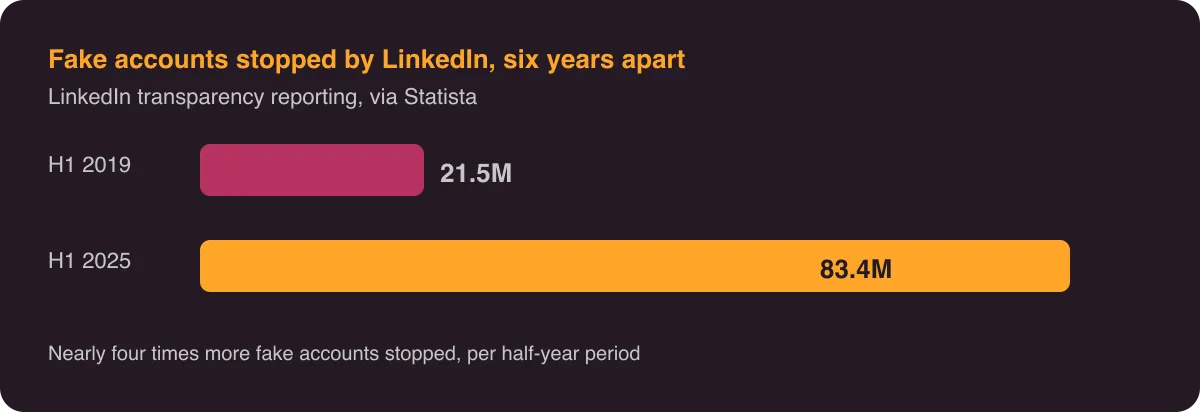
Fake accounts stopped by LinkedIn, first half of 2019 vs first half of 2025. Source: LinkedIn transparency reporting, via Statista.
And the enforcement is not limited to fake accounts. LinkedIn’s VP of Product Management, Gyanda Sachdeva, said the platform will “crack down on any third party tools, like a browser extension or a plug-in, that’s automating any kind of manipulation by commenting on a bunch of posts at the same time” (Social Media Today). Lempod, one of the best-known pod tools, was removed from the Chrome Web Store. That is an executive naming the exact category, and a platform acting on it.
The escalation has continued since. In late July, LinkedIn shipped a ‘Seems like AI slop’ report option and disclosed that it blocks hundreds of thousands of automated comment attempts every day (TechCrunch). We covered what the slop button actually changes.
There is a quieter front in the same war. More than 60% of LinkedIn content is now estimated to be at least partly AI-generated, and fully AI-generated posts take a reach penalty in the range of 30-40% (Algorithm Insights Report 2026, Richard van der Blom). The platform is already discounting content that performs authenticity instead of having it.
Do LinkedIn engagement pods still work?
As a way to inflate a like counter, yes. As a growth strategy, no, and the window is closing on the counter too.
Think about what a pod looks like from the detection side. The same group of people. Engaging with each other’s posts. Within minutes of publishing. In both directions. With almost no conversation happening downstream of the likes. A pod is not a clever hack hiding in the noise. A pod is a coordination pattern wearing a trench coat, and coordination patterns are precisely what LLM-based detection was built to find.
Reddit’s purge showed how this generation of enforcement works: quietly, at scale, and after the fact. The posts that agency seeded did get cited. Then they got deleted, and every citation built on them died with them. Anyone running a pod today is accumulating exactly that kind of debt.
Is LinkedIn really detecting pods with 97 percent accuracy? We checked.
While researching this article, we kept meeting the same three claims: that LinkedIn detects pod activity with ninety-seven percent accuracy, that detected accounts collapse from thousands of impressions to a few hundred overnight, and that detection rates rose by several hundred percent in two years.
We tried to trace every one of them to a primary source. As of July 2026, we could not find one.
| Circulating claim | Primary source found | Verdict |
|---|---|---|
| ”LinkedIn detects pods with ninety-seven percent accuracy” | None. Marketing blogs citing other marketing blogs | Unverified |
| ”Impressions collapse from thousands to a few hundred overnight after detection” | None. Anecdotes, no dataset | Unverified |
| ”Detection rates rose several hundred percent since 2023” | None. No LinkedIn statement, no study | Unverified |
What we found instead was a circular citation loop: a dozen blogs quoting the same figures, every citation pointing at another blog, and nothing at the center. No LinkedIn announcement. No dataset. No named researcher.
To be precise about what this means: none of these claims is proven false. The crackdown itself is confirmed by LinkedIn’s own transparency report, its own executive, and a delisted pod tool. But the specific numbers circulating about that crackdown have no visible source, and repeating them would be manufacturing authority the same way a seeded Reddit post manufactures experience.
We wrote an article about manufactured authenticity. Quoting manufactured statistics inside it would have been a strange way to make the point.
Does seeding posts work for answer engine optimization?
Briefly, yes. Then you lose everything at once.
The agency in Bloomberg’s reporting got its planted posts cited by ChatGPT within a day. Reddit removed them shortly after, and at the next crawl, the citations built on those posts die too (Bloomberg). That is the shape of every seeded-content strategy: rented visibility with a landlord who is getting better at checking IDs.
Earned visibility works on the opposite curve. Slower to start, nothing to confiscate, and it compounds with every purge because each sweep removes competitors while your own record stands.
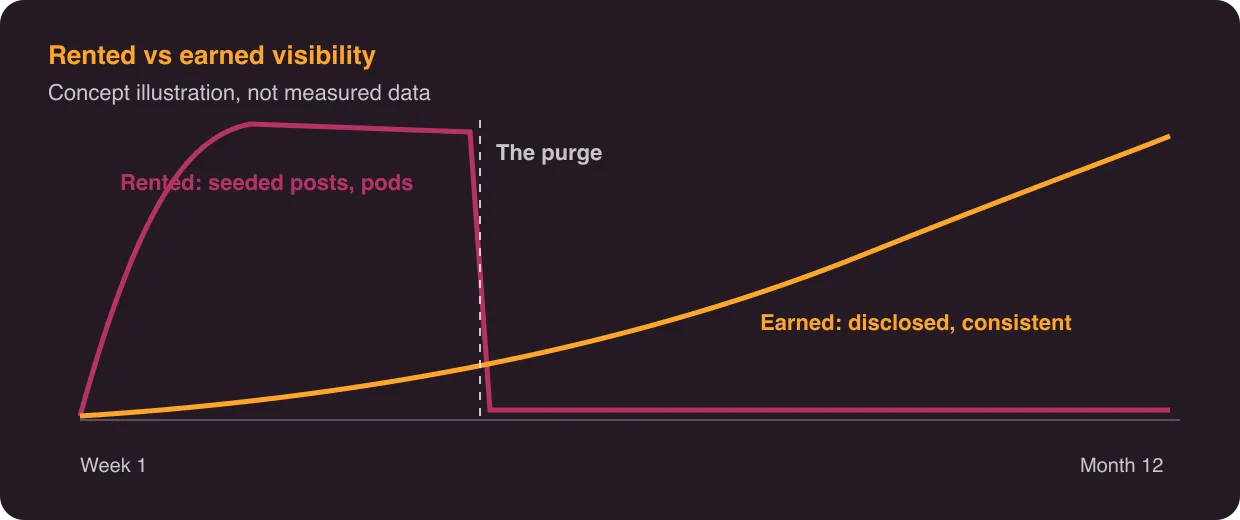
Rented visibility dies at the next purge, the pattern Reddit’s removals just demonstrated (Bloomberg). Earned visibility compounds through it. Concept illustration, not measured data.
What survives the purge
The strategy that survives every version of this crackdown is the least glamorous one: participation you actually did, under your own name, consistently, in the conversations your buyers already read.
Not because platforms are sentimental about authenticity. Because it is the one pattern LLM detection cannot flag: there is no coordination to find. Real comments with real substance are already the highest-paying engagement on the platform, and the mechanics of doing that daily are a solved problem. Start with why commenting beats posting, use the comment-first tactics that compound, and fix your feed so you can see the right posts before the thread fills up. That last problem, seeing the right posts early without an algorithm in the way, is the one BossFeed exists to solve.
Slower than a pod. Duller than a bot. And the only one of the three that is still standing after the sweep.
Frequently Asked Questions About LinkedIn Engagement Pods
Do LinkedIn engagement pods still work in 2026?
They can still inflate a like counter. They no longer buy durable reach, and the direction of enforcement is one-way: LinkedIn's VP of Product has said the platform will crack down on tools automating coordinated engagement, and pod behavior is the most detectable coordination pattern there is.
Am I shadow banned on LinkedIn?
Restricted distribution is real, but the viral statistics about detection accuracy and overnight reach collapses have no primary source that we could find as of July 2026. If your reach dropped, the confirmed causes are more ordinary: off-topic content, low-substance engagement, or association with coordinated activity.
Is using bots or automation against LinkedIn's rules?
Yes. LinkedIn's User Agreement prohibits third-party automation, and enforcement is not theoretical: roughly 83 million fake accounts were stopped in the first half of 2025 alone, and known pod tools have been removed from the Chrome Web Store.
What should I do instead of joining a pod?
Earn the engagement a pod fakes. A small number of substantial comments each day, on the right posts, under your own name, builds the same visibility a pod rents, except it compounds and nothing can confiscate it.
We started this article with an agency admitting its fake posts got cited within a day. We will end it with what we found while checking the crackdown everyone is writing about: marketing blogs quoting each other, with nothing at the center. The statistics about fake engagement turned out to be fake too.
That is the whole era in one sentence. Rent your reach and you are one purge away from zero. Earn it and there is nothing to purge.

Co-founder, BossFeed, VeryCreatives