
August 17, 2026 · 5 min read
How often should you post on LinkedIn? Wrong question.
A famous entrepreneur says post many times a day. Here is the math nobody does: every post is a conversation you now have to attend. Capacity, not cadence.
Gary Vaynerchuk told people to post up to fifteen times a day. The data says something more interesting, and the math says something nobody wants to hear.
Key Takeaways
- Gary Vaynerchuk publicly advised posting “eight to 15 times a day” on LinkedIn, reasoning that the feed only shows each follower a fraction of what you publish (via Melanie Goodman, August 2026)
- A study of 26,428 creators found 2 to 4 posts a week optimal for typical accounts, and fewer than 2% of creators even attempt multiple posts a day (MagicPost)
- The frequency debate measures the wrong thing. Your scarce resource is not content. It is engagement capacity: every post opens a conversation you now have to attend.
- Comments drove 79.9% of where I appeared on LinkedIn last month. Posts drove 18.8% (my own LinkedIn analytics).
This week, one of the most-followed business voices on the planet told his audience to post on LinkedIn up to fifteen times a day. His logic: the feed never shows every follower everything you publish, so nobody experiences it as spam (via Melanie Goodman).
Gary Vaynerchuk is a serious entrepreneur, and the feed-sampling logic is not wrong. The advice still is, for almost everyone reading it. Not because the number is too high. Because the question it answers, how often should I post, measures output on a platform that pays for presence.
Let me show you the difference.
How often should you post on LinkedIn?
Here is the honest, data-backed answer before the reframe. Across 26,428 creators tracked for a year, 2 to 4 posts a week was the sweet spot for typical accounts, generating around five times the weekly engagement of near-silent profiles. Daily posting scored higher still, and fewer than 2% of creators at that scale even attempt multiple posts per day (MagicPost).
So: a few times a week, daily if you can genuinely sustain it. That is the cadence answer, and if that is all you came for, you have it.
But stay for one more minute, because the cadence answer hides the real constraint. The question is not how many posts you can produce. It is how many conversations you can attend.
What the volume advice gets right, and what it misses
Give the advice its due. The feed really does sample. The same study found no cliff where posting more starts hurting your weekly totals, and daily posters earned roughly eight times the weekly engagement of infrequent ones.
Notice what those numbers are made of, though. Likes. Weekly like totals climb with volume because a like costs the giver nothing and the getter nothing. The same study shows the other side: as frequency rises, each individual post earns less, sliding from 29 likes toward 8. Volume grows the pile. It shrinks every piece.
And the advice comes from someone with a production team behind every channel. For a media operation, fifteen posts a day is a workflow. For a founder with a calendar, it is a promise you cannot keep, because the post is not the end of the job. It is the start of one.
The math nobody does: engagement capacity
A post is not a broadcast. It is an opening move. Someone comments, and now there is a thread with your name at the top, in front of exactly the audience you wanted, waiting to see whether a human shows up.
Now run the math on a normal founder’s day. Say you have forty-five minutes for LinkedIn. One post with an attended comment section: every reply answered, follow-up questions asked, the thread alive for a day. Three posts: a skim. Fifteen posts: you did not attend a single conversation you started. You spent the whole budget manufacturing openings and honored none of them.
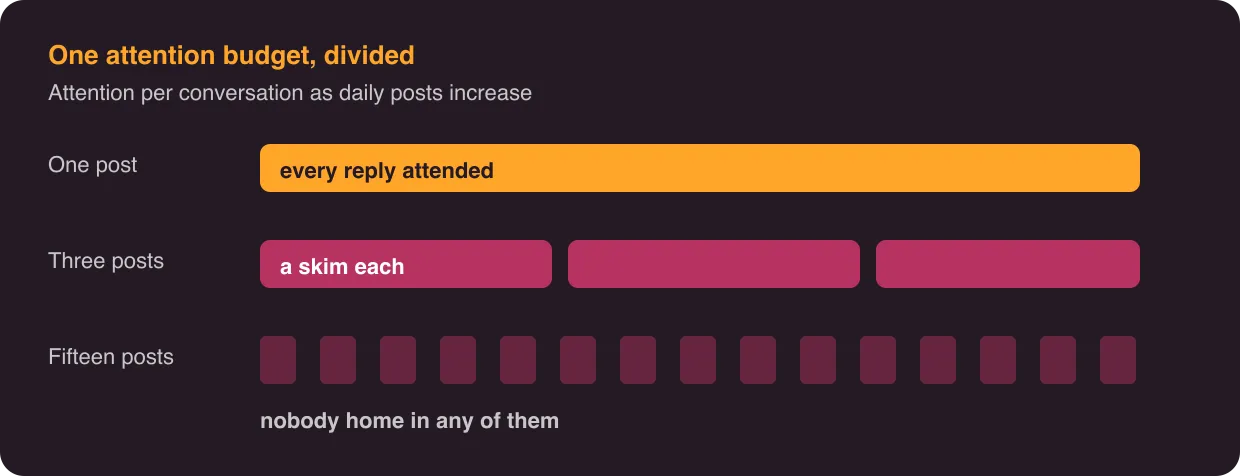
The study’s own per-post numbers show the dilution, with individual posts sliding from 29 likes toward 8 as frequency rises (MagicPost). Concept illustration, not measured data.
And there is a second cost, the one we keep writing about. Nobody writes fifteen original, human posts a day. At that volume something gets automated, and automated is exactly what LinkedIn is hunting: the platform already blocks hundreds of thousands of automated comment attempts daily (TechCrunch). Volume advice, followed honestly, marches you straight into the classifier’s field of fire.
Do you need a LinkedIn posting schedule?
A modest one, yes. Two to four slots a week you can actually fill with something original is a schedule that survives contact with a founder’s calendar.
But build your engagement schedule first. A daily fifteen-minute window for showing up in other people’s threads compounds faster than a content calendar you cannot service, because commenting beats posting for reach per minute, and it never leaves a comment section of your own unattended. The tactics are in the comment-first playbook.
What to do instead of posting more
Reallocate. Fewer posts, fully attended. Then spend the freed minutes where the payoff actually is: in the conversations your buyers already read.
I run this trade myself, and the analytics settle the argument. Last month, comments drove 79.9% of where I appeared on LinkedIn. My posts, published about once a week, drove 18.8% (my own LinkedIn analytics). One well-attended post a week plus a daily comment routine beats a content calendar I could never keep, and finding the right threads fast enough to matter is the one job I let BossFeed do.
Post less than the volume gurus say. Attend more than anyone says. The feed forgets a fifteenth post by lunch. It remembers who showed up in the thread.
Frequently Asked Questions About LinkedIn Posting Frequency
How often should I post on LinkedIn?
For typical accounts, 2 to 4 posts a week was the measured sweet spot across 26,428 creators, with daily posting scoring higher for those who can sustain it. The better rule: post as often as you can write something original and still attend the conversation it starts. For most operators that is a few times a week.
Is posting every day on LinkedIn too much?
Not by the data, daily posters earned roughly eight times the weekly engagement of infrequent ones, with no measured cliff. The real limit is capacity: fewer than 2% of creators sustain multiple posts a day, and an unattended comment section costs you more than a skipped post does.
Does posting more increase your reach?
Your weekly totals rise, but each individual post earns less as frequency climbs, sliding from 29 likes toward 8 in the measured data. Past your capacity to write originals, volume also forces automation, which LinkedIn's classifiers block at industrial scale (TechCrunch).
What matters more than posting frequency?
Presence. Answered threads on your own posts and daily comments on the right people's posts. Last month, comments drove 79.9% of where I appeared on LinkedIn while my posts drove 18.8% (my own LinkedIn analytics), and that split is the whole argument: the platform pays for showing up, not for shipping.
Everyone is asking how often to post, and the honest answer fits in a sentence. The question that separates operators from broadcasters is different: how much of what you start can you actually attend?
Post less than you think. Show up more than you post.

Co-founder, BossFeed, VeryCreatives