
July 16, 2026 · 6 min read
The LinkedIn Interest Graph: your comments decide your lane
LinkedIn files you under a topic and resurfaces you for it. Everyone says pick a lane and post more. The data says your comments decide your lane just as much.
Everyone says pick a lane and post about it. Half right. The algorithm is also reading where you show up, and it believes that half more.
Key Takeaways
- LinkedIn shifted from a relationship graph to an Interest Graph: content travels by topic relevance, not connections. Posts from your direct connections fell from 72% of the feed in 2024 to 31% in 2026 (Algorithm Insights Report 2026, Richard van der Blom)
- The graph builds a topic fingerprint for you from behaviour: what you post, comment on, save, and read. Off-topic engagement dilutes it (same source)
- Comments are your most public topic signal. Mine drove 79.9% of where I appeared on LinkedIn (my own LinkedIn analytics)
- Which means you can sharpen what you are known for without changing what you publish. Comment in your lane, daily.
Everyone has the same answer to LinkedIn’s new algorithm. Pick a lane. Post consistently inside it. Wait to be recognized as the person for that topic.
It is not wrong. It is half the picture. The half nobody mentions: LinkedIn is not just reading what you publish. It is reading what you do, and your behaviour outweighs your intentions.
So before we go any further, one honest question. What do your last thirty comments say you are about?
What is the LinkedIn Interest Graph?
The LinkedIn Interest Graph is the distribution system LinkedIn moved to in 2025. It routes content by topic relevance instead of connections: every member and every post gets a topic fingerprint, and posts travel to the feeds of members whose fingerprints match, whether or not they follow the author.
The shift is visible in the numbers. Posts from direct connections fell from 72% of the average feed in 2024 to 31% in 2026, while posts from people outside your network, matched purely by topic, climbed to a quarter of the feed, and algorithmic suggested posts to another tenth (Algorithm Insights Report 2026, Richard van der Blom).
We covered what that does to the feed you read. This article is the other side of it: what it does to the feed you appear in. It also demotes an old goal: follower count has decoupled from reach.
How does LinkedIn decide what you are about?
Not by reading your headline. By watching your behaviour.
Every action feeds your fingerprint. The topics you post about. The posts you comment on. The content you save. Even what you slow down to read. LinkedIn folds all of it into a continuously updated picture of your professional interests, and it distributes your content based on that picture, not on the audience you think you are building (Algorithm Insights Report 2026, Richard van der Blom).
Here is the uncomfortable part from the same research: engaging with content outside your lane dilutes the signal. That viral post you commented on last week because everyone else was there? To your readers, it was a throwaway. To the graph, it was a vote on what you are. Enough votes like that and the system genuinely does not know what to resurface you for.
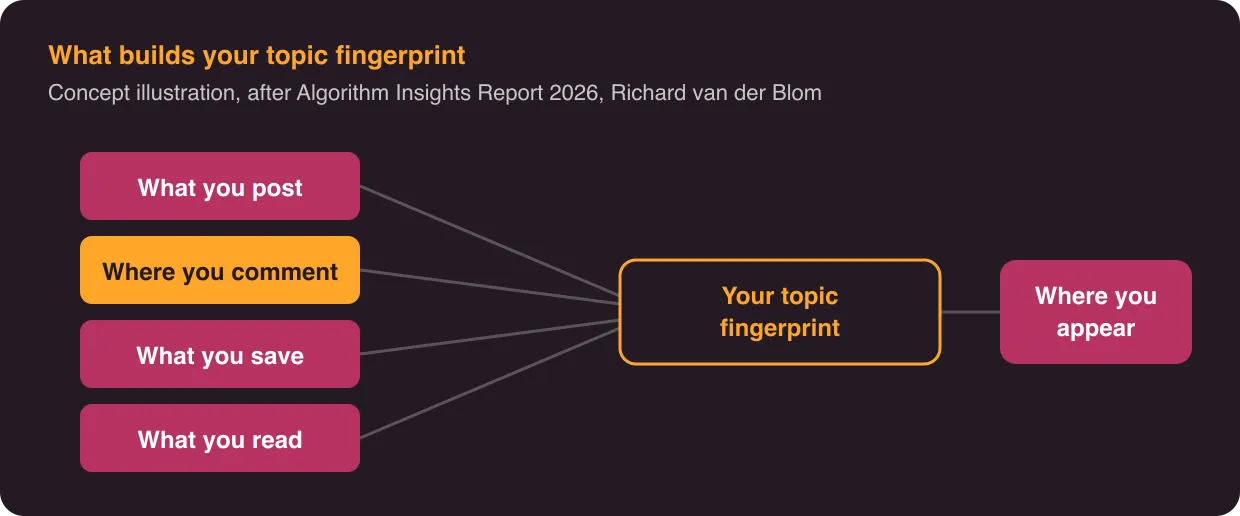
Your fingerprint is built from behaviour, and comments are the loudest behavioural signal you control daily. Concept illustration, after Algorithm Insights Report 2026, Richard van der Blom.
Why your comments count double
Because a comment is the only signal that is public and legible at the same time. Readers see it: your name, your take, in a thread your buyers already follow. The graph reads it too: another data point filing you under the topic you commented on.
The research points the same way. Commenting consistently with a set of people in your field puts your content in their feeds and theirs in yours, a mutual visibility loop the report calls engagement clusters (Algorithm Insights Report 2026, Richard van der Blom).
And I can show you what that looks like in practice. Comments drove 79.9% of where I appeared on LinkedIn. My posts drove 18.8% (my own LinkedIn analytics). We publish around three times a week. My lane visibility is not post-built. It is comment-built.
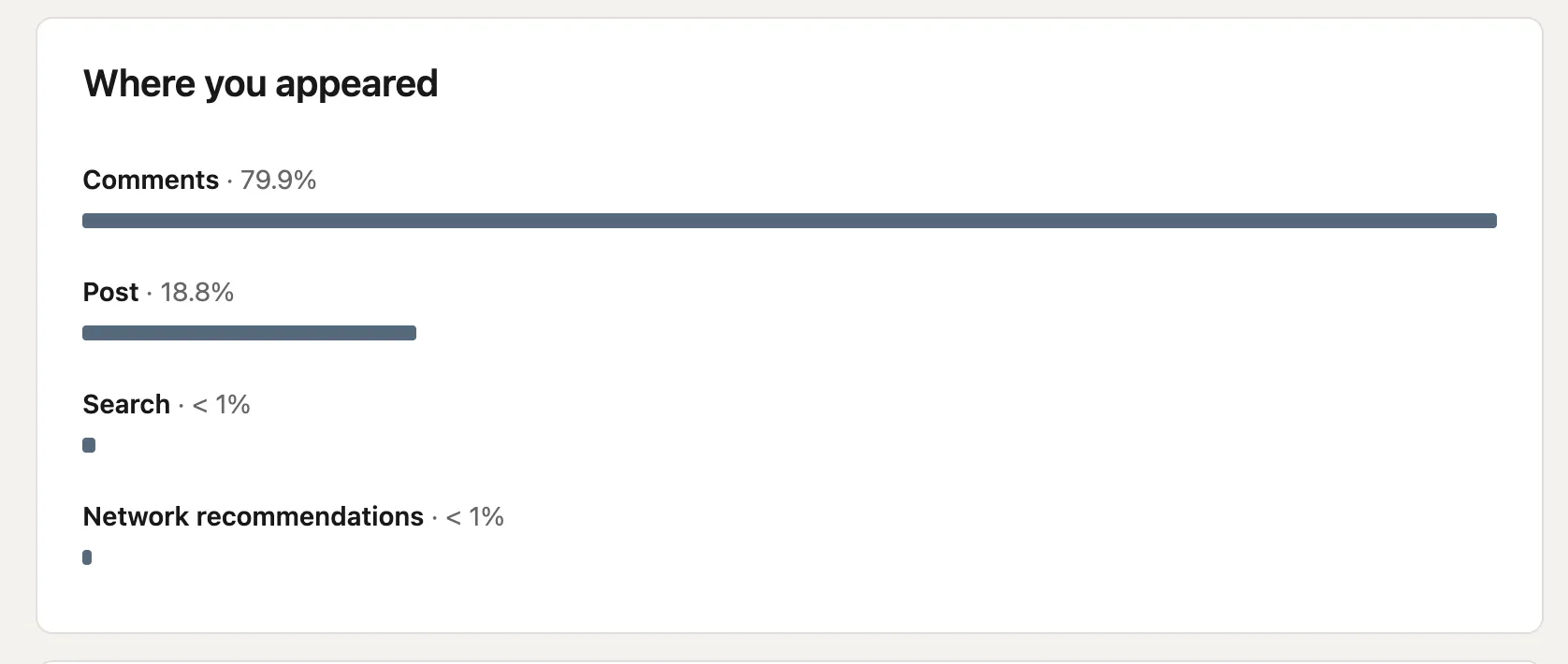
Where I appeared on LinkedIn: comments first, posts a distant second. My own LinkedIn analytics.
Your grid says what you want to be known for. Your comments say what you actually show up for. The graph believes the second one.
How to build topic authority without changing what you post
Five moves. None of them touch your content calendar.
- Write your lane in one sentence. Who you help, and with what. If you cannot compress it to a sentence, the graph cannot compress it to a fingerprint, and it will not know what to resurface you for.
- Curate the 100 to 200 in-lane voices, and comment there daily. Prospects, customers, peers, the people your buyers already read. This list is where your lane actually gets built. Keeping that list in front of you instead of the algorithm’s picks is the one job BossFeed was built for, but a disciplined bookmark folder works too.
- Skip the off-topic viral bait. Even when it is easy reach. Every interaction is a vote on what you are, and the graph counts every vote.
- Save and read in your lane too. The quiet signals count. You are not just training your audience. You are training your own graph.
- Audit your last thirty comments, not just your grid. Would a stranger reading only your comments know your lane in half a minute? If not, the problem is not your content strategy.
Does going deep on one topic box you in?
No, and the fear gets the mechanics backwards.
A lane is a territory of problems, not one post repeated until everyone is bored. “Helping B2B founders turn LinkedIn into pipeline” leaves room for stories, failures, client work, contrarian takes, and industry news, as long as they orbit the same core problem. You are not shrinking what you are allowed to say. You are sharpening the label you get filed under. Those are different things, and only the second one is the graph’s business.
So what should you post about on LinkedIn?
Inside your lane, in a few repeatable shapes you can sustain. That is the publishing half, and it matters.
But it is half. Discoverability under the Interest Graph is also built where you show up: in the comments of the conversations your buyers already read. The habit is covered in why commenting beats posting, and the tactics in the comment-first playbook. If your headline needs to catch up with your lane, fix your profile while you are at it.
Frequently Asked Questions About the LinkedIn Interest Graph
What is the LinkedIn Interest Graph?
It is the distribution system LinkedIn moved to in 2025, which routes content by topic relevance instead of connections. Every member and every post gets a topic fingerprint, and posts travel to members whose fingerprints match, follower or not. The result: posts from direct connections fell from 72% of the feed in 2024 to 31% in 2026 (Algorithm Insights Report 2026, Richard van der Blom).
Do my comments affect how the algorithm sees me?
Yes, directly. Your topic fingerprint is built from behaviour: what you post, comment on, save, and read, and engaging off-topic dilutes it (Algorithm Insights Report 2026, Richard van der Blom). A comment is also the only signal your audience and the algorithm read at the same time, which is why it counts double.
How many topics should I focus on?
A small set of connected themes orbiting one core problem, few enough that a stranger could name your lane in half a minute. The research behind the Interest Graph points to a handful of consistent professional themes, not one note played on loop (Algorithm Insights Report 2026, Richard van der Blom).
Can I change my lane on LinkedIn?
Yes. The fingerprint updates continuously, so it follows your behaviour into the new lane. Expect a transition period while consistent new signals outweigh the old ones, and shorten it the same way you built the first lane: post, comment, save, and read where you want to be filed next.
Everyone is arguing about what to post. The graph is quietly reading where you comment.
Your lane is not declared. It is demonstrated.

Co-founder, BossFeed, VeryCreatives