
August 18, 2026 · 5 min read
How to get more followers on LinkedIn? Wrong goal.
Everyone is chasing followers. Meanwhile counts grew while reach fell, and the accounts winning now are smaller and sharper. Here is what to build instead.
Follower counts went up. Reach went down. Both are true at once, and the reason changes what you should be building.
Key Takeaways
- Across the latest research period, median follower counts grew 31% while median impressions fell. Follower count and reach have been structurally decoupled (Algorithm Insights Report 2026, Richard van der Blom)
- The same research puts it plainly: a creator with 8,000 focused followers can now outperform one with 80,000 unfocused ones
- Followers and connections are different mechanics, and in 2026 neither is the distribution asset people assume. Connections fell to under a third of the average feed.
- The replacement goal: stop growing an audience, start choosing one. The right 100 to 200 names, and daily presence in their threads.
Every LinkedIn guide ends on the same slide. Grow your following. Bigger audience, bigger reach, bigger pipeline.
Meanwhile, the strangest data point of the year sits mostly unread: follower counts went up, and the reach they were supposed to buy went down. Not for a few unlucky accounts. As the median.
So before you spend another quarter optimizing that number, one honest question. When did one of your followers last turn into a conversation?
How do you get more followers on LinkedIn?
The honest answer fits in four lines, and none of it is secret. Pick one lane and post inside it consistently, because the algorithm files you by topic and resurfaces you for it. Comment daily where your buyers already read; visible, substantive comments are the most reliable follower source that exists. And make your headline say your lane, because people follow a clear label, not a job title. And on cadence, fewer well-attended posts beat volume.
Do that for a quarter and your count will climb. Now the better question, the one this article is actually about: what does that number buy you in 2026?
Followers vs connections on LinkedIn: what is the difference?
The mechanics first, because the two get blurred constantly. A connection is mutual: both sides accept, you can message each other, and the network is capped at 30,000 per account. A follower is one-way: no approval, no cap, they see your posts and you see nothing of theirs. Connecting with someone makes you followers of each other automatically, which is why every connection is also a follower, but not the reverse (LinkedIn Help).
So which should you collect? In 2026, the question mostly misses. Posts from your connections fell from 72% of the average feed in 2024 to 31% in 2026 (Algorithm Insights Report 2026, Richard van der Blom), and follower count has decoupled from reach, as the next section shows. Connections still matter for one thing followers never give you: the message thread. As distribution assets, neither is what people think.
More followers, less reach: the decoupling
Here is the finding that should reorganize your LinkedIn goals. Across the research period behind the Algorithm Insights Report 2026, median follower counts grew 31% while median impressions fell. If reach had simply tracked audience growth at a neutral ratio, impressions would have been roughly 29% higher than what was actually recorded (Algorithm Insights Report 2026, Richard van der Blom). The subscribers showed up. The distribution did not.
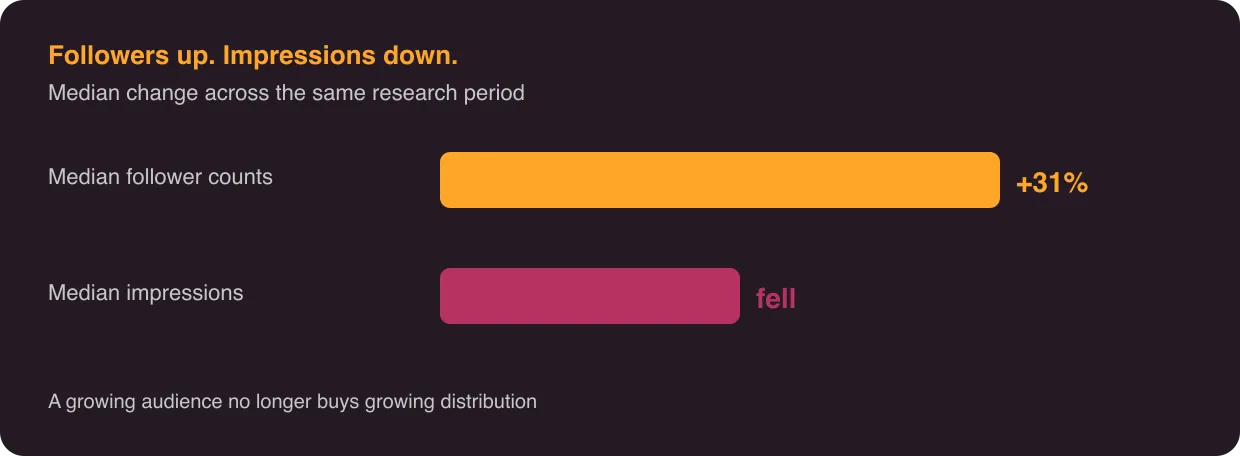
Median follower counts grew while median impressions fell. Source: Algorithm Insights Report 2026, Richard van der Blom.
The report’s own conclusion is blunter than anything we would write: your follower count tells you almost nothing about your reach potential in 2026, and your topic consistency tells you everything. The algorithm decides post by post whether your subscribers see you, based on the relevance of what you just published, not on the size of the list that once opted in.
The follower count is a scoreboard for a game LinkedIn stopped running.
Why 8,000 beats 80,000
The same research offers the sharper version: a creator with 8,000 focused followers can now outperform one with 80,000 unfocused ones (Algorithm Insights Report 2026, Richard van der Blom).
The mechanism is the one we covered in the Interest Graph piece: distribution routes by topic fit between your content and each reader’s fingerprint. An audience that followed you for one viral post is dead weight in that system. They do not engage, their fingerprints do not match yours, and every impression spent on them teaches the algorithm your content lands with nobody. A small audience that engages is not a consolation prize. It is the input the system was built to reward.
Size was the metric of the broadcast era. Fit is the metric now, and fit does not show up on your profile as a number anyone can admire.
What to build instead of an audience
Choose one. Deliberately. The 100 to 200 names your business actually runs through: prospects, customers, peers, the voices your buyers trust. Then be present in their threads daily, with comments that could stand alone, and let following happen as the byproduct it always was.
That is not a consolation strategy for small accounts. It is where the results were hiding all along: comments drove 79.9% of where my co-founder appeared on LinkedIn last month, against 18.8% from his posts, straight from his own LinkedIn analytics. The playbook is documented in why commenting beats posting and the comment-first tactics; the part most people fail at, actually seeing those 200 names’ posts every day instead of the algorithm’s picks, is the problem BossFeed was built to solve.
Followers will still accumulate. Let them. Just stop mistaking the exhaust for the engine.
Frequently Asked Questions About LinkedIn Followers
How many followers do you need on LinkedIn?
There is no threshold, because distribution no longer checks the count. The system routes each post by topic fit, and the research is explicit that follower count tells you almost nothing about reach potential while topic consistency tells you everything. A few hundred of the right followers can out-produce tens of thousands of the wrong ones.
Do LinkedIn followers still matter?
As social proof, somewhat: a bigger number earns a stranger's second look. As distribution, far less than assumed: median follower counts grew 31% while median impressions fell across the same period. Treat the count as a lagging indicator of doing the real work, not as the goal.
Followers vs connections: which is better?
They do different jobs. Connections are mutual, capped, and open a message thread; followers are one-way and unlimited. For distribution, neither decides much anymore; for relationships, connections win, which is why the smart move is connecting with the small set of people you actually engage with and letting everyone else follow.
What actually grows a LinkedIn following in 2026?
A clear lane, consistent posts inside it, and daily visible comments where your buyers already read. Following is a byproduct of being repeatedly useful in the right threads. Chase the byproduct directly and you get the audience the algorithm ignores; do the work and the count takes care of itself.
The follower count survived as a goal because it is easy to see and easy to compare. The thing that replaced it is harder to screenshot: the short list of people who actually read you, reply to you, and buy from you.
Nobody’s pipeline is a follower count. Stop growing an audience. Start choosing one.

Co-founder, BossFeed, VeryCreatives